Asemic Writing in Painting – How to Read It?

The writer Henry Valentine Miller once said that a person is nothing but a text. Following this view, one could argue that everything around a person is also text. But what is text?
We use readable, familiar symbols such as letters and numbers to convey precise information — and to be clearly understood. According to the Book of Genesis in the Old Testament, humanity lost the common language once shared by all, and this is how misunderstanding and miscommunication came to dominate the world. So although we try to communicate through the texts we create, we unfortunately have no universal language.

Emilio Angelini
Artists, who as a rule always stand for freedom, peace and love, try to bring back that old, lost language. This is how the term asemic writing came about. When artists use this kind of script in painting, they are not trying to convey precise information, texts or words. Asemic writing expresses a more abstract idea, a feeling, broader concepts, or simply sets a direction for the viewer's thoughts. Yet it never becomes legible script. Artists draw on the viewer's intuitive understanding and, through aesthetic expression, convey their idea. By abandoning the known meanings of words and letters, asemic writing becomes the equivalent of colors, of words, and of music.

John McConnochie
The variety of asemic writing is enormous, since it is grounded in the art of improvisation. Yet artists maintain that true asemic writing must retain the form of ordinary text — punctuation marks, a chosen typeface, the visual image of text. Often these are also signs resembling hieroglyphs or Arabic script, though likewise carrying no corresponding meaning.

Lucinda Sherlock
In the art world, this concept has been more widely used since the early 20th century. The avant-garde artists were especially fond of this abstract way of writing. One of the best-known creators of asemic writing was the Argentine artist Mirtha Dermisache, whose exhibitions were held in some of the world's most renowned exhibition halls. She is one of the key artists who brought recognition to the significance of asemic writing. You can see Mirtha's script here.
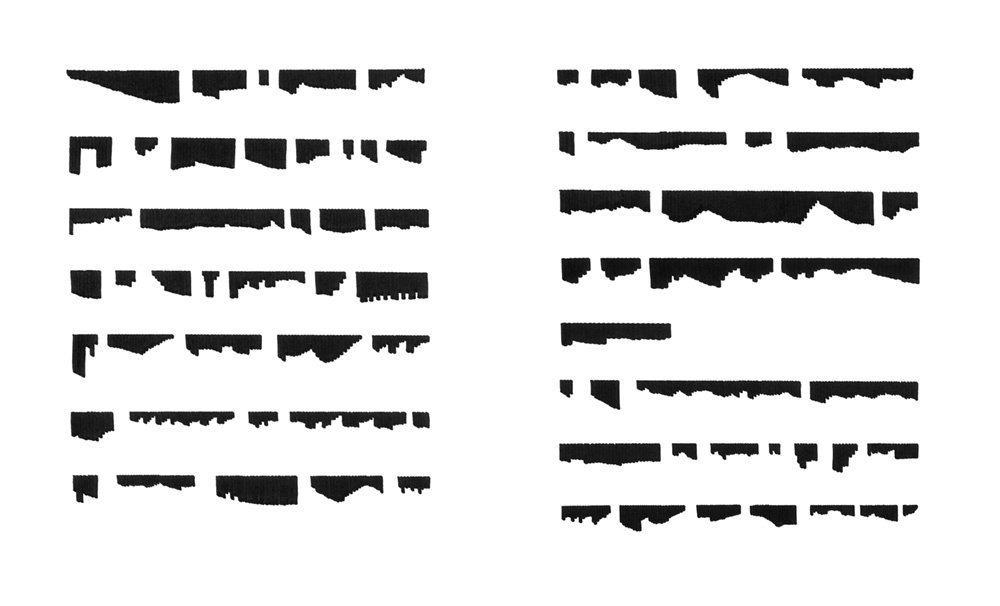
In the Lithuanian art scene, asemic writing is used mainly by painters working in abstraction. Such characters can be found in the paintings of the artist Virginijus Tamošiūnas, where, among broad brushstrokes, an illegible text appears, as if written in cursive letters.

Virginijus Tamošiūnas "Trees and Moons II"
Asemic writing predominates in the abstractions of artist Konstantinas Žardalevičius. The artist uses different typefaces to speak about different ideas — a Gothic typeface, whose aesthetic evokes the Middle Ages, most often symbolizes tradition and the past, while texts in cursive script most often visualize ideas, thoughts, and the future.

Konstantinas Žardalevičius "Asemic Perception"
So such texts in art should be read the same way they are written — abstractly, without trying to discern a specific meaning. The feeling that arises upon seeing the script helps us understand the idea the artist has encoded within it.